On 12 June 2026, a company that builds reusable rockets rang the bell at Nasdaq, sold 555.6 million shares at $135, and became the largest initial public offering in the history of money. It closed the day up 19% at $161 — a market capitalisation of about $2.1 trillion.
For twenty-four years before that morning, SpaceX's finances were a rumour. Analysts reverse-engineered them from leaked decks and tender-offer gossip. Then the company filed a prospectus with an auditor's signature on it, and the rumours had to go and get real jobs.
I sat down with that filing expecting to learn about rockets. The line that stopped me was in the property, plant and equipment note.
Servers: $22,694M. Satellites: $11,949M.
That's the balance sheet at 31 December 2025. SpaceX now has roughly twice as much capital sunk into servers and networking equipment as into the entire satellite constellation.
A year earlier the same two lines read $6,892M and $7,591M — the satellites were winning. In twelve months the server line more than tripled and lapped them. A line item called "data center infrastructure" went from $224M to $2,960M, which is the accounting equivalent of a new wing appearing on your house overnight.
The reason is that SpaceX swallowed xAI in February 2026. Because both companies sat under the same controlling shareholder, the accountants had to restate history as though the merger had always existed — so every historical figure below quietly contains Grok and X too.
The quarter where the capex outran the company
In the first quarter of 2026, SpaceX spent $10,107M on capital expenditure. $7,723M of it — 76% — went to the AI segment.
Total revenue that quarter, across rockets, satellite internet, advertising and AI put together, was $4,694M.
Read those two numbers again in either order. They spent more on AI infrastructure in three months than the entire business earned in three months. This is not a rocket company with an AI division. It is an AI capital programme with a launch provider and an ISP bolted on to help pay for it.
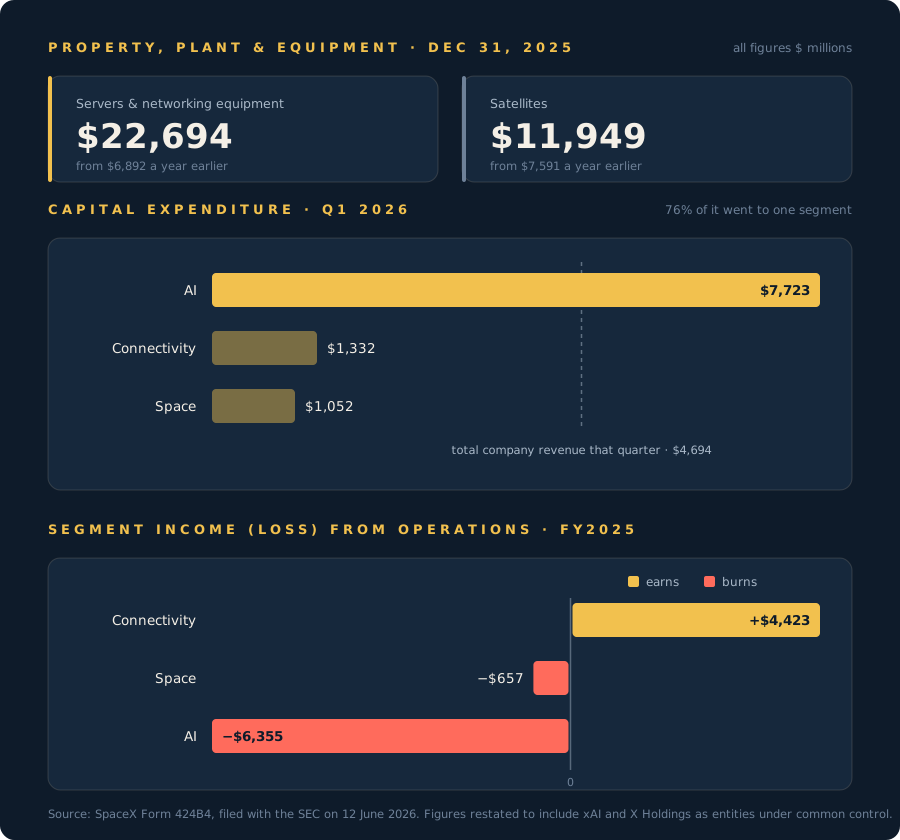
One segment earns. Two burn.
The full-year 2025 segment table settles the argument:
| Segment | Revenue | Income (loss) from operations |
|---|---|---|
| Connectivity (Starlink) | $11,387M | +$4,423M |
| Space (rockets) | $4,086M | −$657M |
| AI (Grok, X) | $3,201M | −$6,355M |
Connectivity grew revenue 49.8% and more than doubled its operating income. It is a genuinely superb business — and it is the only one. That $4.4B of operating profit is the entire structural beam holding up the other two segments and, increasingly, the bond market's opinion of the company.
Consolidated, 2025 brought in $18,674M of revenue and a net loss of $4,937M. The year before, on the same restated basis, SpaceX earned $791M. One year and one acquisition later, a $5.7B swing in the wrong direction.
The rockets quietly became internal logistics
Here's the detail I keep turning over.
SpaceX launched 170 times in 2025, up from 138. It put 2,213 metric tons into orbit, up from 1,699. That's 23% more flights and 30% more mass — an operational record no one else on the planet is close to.
Launch services revenue in 2025: $2,576M. In 2024: $2,584M.
More rockets, more tonnage, slightly less money. The straightforward reading is that most of that extra cadence is SpaceX flying SpaceX's own hardware, and Starlink satellites do not send the launch division an invoice. Falcon 9 is turning from a product into a supply chain.
The company says so itself, in the beige language of a risk factor:
"For those reasons and in order to achieve our orbital compute goals, we may prioritize our own launch payloads over additional U.S. government contracts or third-party customers. This prioritization of launch capacity may limit revenue growth in our Space segment."
About one-fifth of 2025 revenue came from U.S. federal agencies. The prospectus is informing those customers, in writing, that they may find themselves queuing behind the AI roadmap.
Meanwhile the Space segment poured $3,004M into Starship R&D in 2025 — which is how a business with $4.1B of revenue manages to post a loss.
Starlink is buying users with price
The Connectivity numbers hide a second story. Subscribers went from 4.4M to 8.9M across 2025 and reached 10.3M by Q1 2026 — up 106% year over year. Monthly ARPU over that same window went $86 → $66.
Twice the customers at three-quarters of the price. The filing attributes it to international expansion and cheaper plans, and warns ARPU will keep sliding as the base shifts away from North America.
Anyone who has scaled an infrastructure product knows this trade: you buy the next million users with price, and you earn it back on utilisation of capacity you already paid for. It is a good trade — right up until the marginal user costs more to serve than they pay.
What the market did with all of it
The IPO raised about $74.4B net. Nine days later SpaceX sold $25B of bonds across five tranches at coupons from 5.35% to 6.65%, against roughly $89B of orders — the largest debut investment-grade deal by a US issuer this year.
Then the numbers had to stand up on their own.
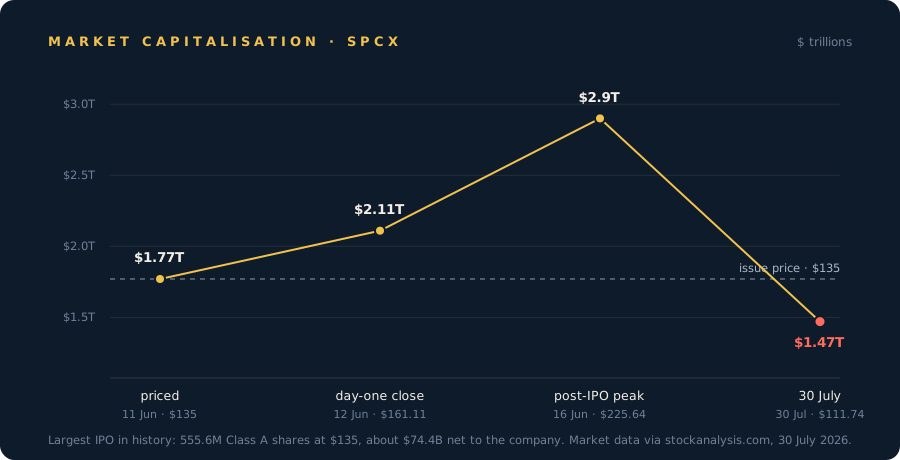
Four days after listing, on 16 June, the stock peaked at $225.64 — a roughly $2.9 trillion company, briefly worth more than Amazon or Microsoft. It closed 30 July at $111.74, below its own issue price and about half off that high, valuing the company near $1.47 trillion.
Two dates are now doing all the work. On 4 August, SpaceX reports quarterly earnings for the first time in its existence. Two trading days later, on 6 August, the first lock-up tranche releases roughly 911.5 million shares. A second tranche of 455.8 million was written to unlock only if the stock held 30% above the IPO price — about $175.50 — into the earnings date. It won't.
Why this sparks my curiosity
In Field Note 002 I argued that the bottleneck decides the architecture — that prefill and decode having opposite appetites was reason enough to split LLM serving across two different machines.
This filing is the same argument, scaled up until it stops being an architecture diagram and becomes a balance sheet. The binding constraint on frontier AI is no longer FLOPs or memory bandwidth. It's power, land and cooling. So a company that happens to own the cheapest ride to orbit looked at that constraint and concluded the sane response is to put the datacenter where the power is unfiltered and the cooling is a vacuum. The prospectus says orbital AI compute satellites start deploying as early as 2028, with Starlink as the network tying them back to the ground.
Whether that works is a genuinely open question, and I'd be lying if I claimed to know. What's no longer open is what it costs to attempt — for the first time, we can all read the invoice.
The reusable rocket was supposed to be the point. On this balance sheet, it's become the loading dock for something else.
The GPUs are new. The capital allocation problem is extremely old.
Sources: SpaceX Form 424B4 — the IPO prospectus (SEC, 12 June 2026) · SPCX closes day one at $161 · SpaceX prices $25B debut bond sale · Earnings date and lock-up schedule · Market data via stockanalysis.com, 30 July 2026
Somoprovo, by firelight 🏕️